
As a yoga practitioner, you’ve probably heard all sorts of yoga speak being shared in the classes you attend. Claims that one pose can “open your heart,” or that another can “bring on strong emotions.” You may hear teachers say, “This pose is good for anxiety,” or “These poses help to cleanse your internal organs.” As a student, you’ve likely thought to yourself, “Sweet! I want my internal organs to be clean!” Or, maybe you didn’t experience the intense emotions you were promised, and you felt disappointed. Yogaland is rife with health claims about poses. There’s a lot of lore out there. Phrases heard in a yoga class can offer us comfort in times of great suffering, or can sometimes be confusing and leave us feeling skeptical. Over the next few months, through the lens of science and movement mechanics, I’ll decode some of these claims and some of the loftier, health-related and psychological assertions about the poses.
First up: forward folds.
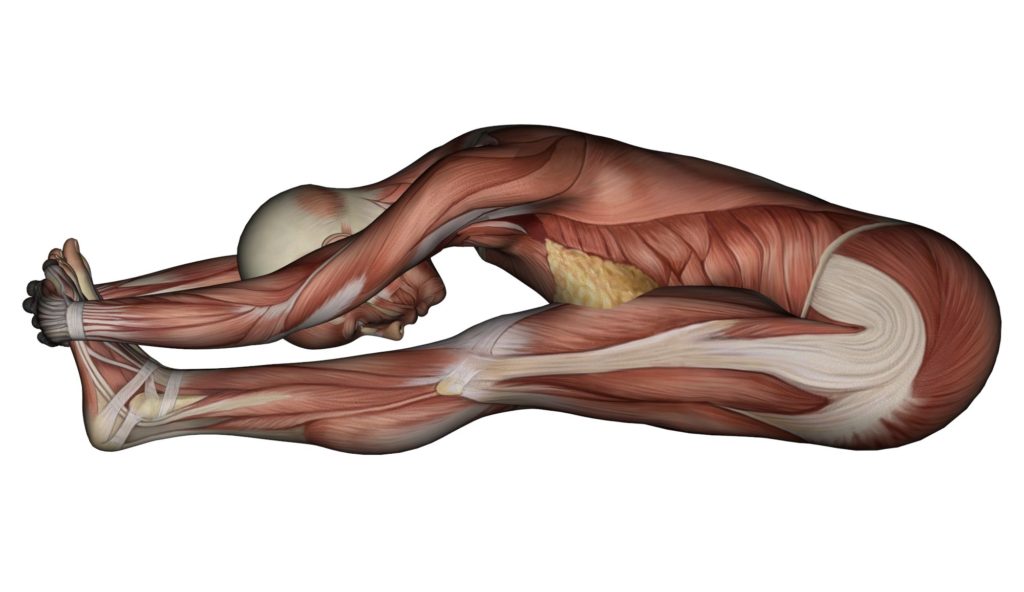
Forward-folding postures are repeatedly described as being poses that shift our awareness from the outside world to the inner world. Often, during postures like paschimottanasana, or seated forward bend, you will hear teachers say something like, “Fold forward and turn your attention inward.” These poses are said to be calming, cooling, and promote introspection. Physically, these poses strengthen the muscles on the front of the body while also stretching the muscles along the backside of the body.
So, what is really happening in these poses that would promote internal awareness? To understand this, we have to look at two things: the muscles responsible for flexing the trunk, and the collection of nerves that run along the spine.

Muscularly, it’s the iliopsoas that is responsible for bringing the trunk of the body toward the thighs. The iliopsoas complex refers to the joined psoas and iliacus muscle. The psoas major is a long, ropy muscle that begins at the lower portion of your mid-spine and joins with the iliacus muscle, located at the top of the pelvis. These muscles then traverse over the front of your hips, forming the hip flexors, and attach on your inner thigh bones. This “complex” of muscles fold the body in half in the forward direction – folding us into ourselves.
As the front of the body works to pull the chest toward the thighs, the muscles along the spine lengthen. When the spine lengthens, the nerves that run along the spine are stimulated. These nerves are part of the body’s parasympathetic nervous system. The parasympathetic nervous system is often called the “rest and digest” system of the body. It conserves energy by relaxing the heart rate, increasing intestinal and gland activity, and relaxing the digestive muscles in the gastrointestinal tract.
The keyword here is “relax.” To receive the calming effect offered by forward bending, relaxation is key. If the hip flexors and psoas muscle are in a weakened state, or the hamstrings or muscles along the spine are tight, forward folding may feel more like striving. The idea of “going within” may feel like an unachievable feat.
It is vital to find a variation of the pose that takes your unique body into account. Widening the position of the legs, adding a block or blanket under your seat, and bending the knees, will allow the torso to meet the thighs more fully. By doing so, the back body will lengthen, and the nerves that run along it can receive the calming communication from the parasympathetic nervous system.
Grab some props, explore, and happy practicing!